365 Days a Year,
365 Family History-Genealogy Rules
19. DNA can lead to NPE.
NPE = Not Parent Expected




| i. | Charles Bernard DESPEGHEL was born 25 Aug 1822 in Klerken. | ||
| ii. | Jan Baptiste DESPEGHEL was born 11 Dec 1823 in Klerken, and died 30 Jan 1824 in Klerken. | ||
| iii. | Franciscus Bernard DESPEGHEL was born 20 Dec 1824 in Klerken. | ||
| iv. | David Alexander DESPEGHEL was born 17 Jun 1826 in Klerken, and died 13 Sep 1826 in Klerken. | ||
| v. | Virginia Sophie DESPEGHEL was born 13 Oct 1827 in Klerken, and died 29 Jan 1839 in Klerken. | ||
| vi. | Maria Theresa DESPEGHEL was born 27 Oct 1828 in Klerken, and died 17 Jun 1829 in Klerken. | ||
| vii. | David Alexander DESPEGHEL was born 3 Apr 1830 in Klerken. | ||
| viii. | Amand Joseph DESPEGHEL was born 10 Sep 1831 in Klerken, and died 20 Dec 1833 in Klerken. | ||
| ix. | Marie Theresa DESPEGHEL was born Nov 1832 in Klerken, and died 15 May 1834 in Klerken. | ||
| x. | Leonard Joseph DESPEGHEL was born 6 Oct 1834 in Klerken. | ||
| xi. | Bruno DESPEGHEL was born 10 Feb 1836 in Klerken, and died 25 Apr 1837 in Klerken. | ||
| xii. | Emiliana Sophia DESPEGHEL was born 26 Nov 1839 in Klerken. |
| m. Barbara Carolina TUYTTEN 12 Sep 1840 in Klerken, daughter of Joseph TUYTTEN and Angela Josepha WULLEPUT. She was born 1810 in Woumen, and died 15 Dec 1842 in Klerken. No listed issue. 3rd marriage to m. Amelia DEBRUYNE 21 Sep 1843 in Langemark, daughter of Joannes Innocent DEBRUYNE and Barbara Theresa PROVOOST. She was born 8 Oct 1801 in Langemark. No listed issue | |



 |
| Edgar Boardman Jewett |
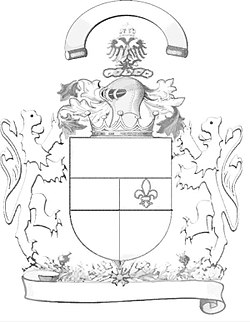 |
| A blank Coat Of Arms. Each area is designated for certain elements. The following diagram lists out what achievement goes where on the Coat Of Arms. Very strict rules by the way. |
 |
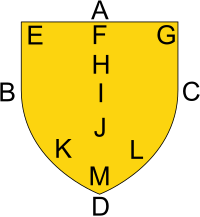
Examples of escutcheon shapes: 1: mediaeval French & English "heater style"; 2: modern French; 3: cartouche (oval); 4: lozenge (usually borne by women); 5: rectangular; 6: Italian; 7: Swiss, 8: English,Tudor arch (16th century); 9: à bouche; 10: Polish; 11: traditional IberianInescutcheons as mobile charges[edit]
Inescutcheons may appear in personal and civic armory as simple mobile charges, for example the arms of the House of Mortimer or the noble French family of Abbeville. These mobile charges are of a particular tincture but do not necessarily bear further charges and may appear anywhere on the main escutcheon, their placement being specified in the blazon, if in doubt.
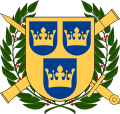
Inescutcheons may also be charged with other mobile charges, such as in the arms of the Swedish Collegium of Arms (illustrated below) which bears the three crowns of Sweden, each upon its own escutcheon upon the field of the main shield. These inescutcheons serve as a basis for including other charges that do not serve as an augmentation or hereditary claim. In this case, the inescutcheons azure allow the three crowns of Sweden to be placed upon a field, thus not only remaining clearly visible but also conforming to the rule of tincture.
Inescutcheon of pretence[edit]
Inescutcheons may also be used to bear another's arms in "pretense".[note 1] In English Heraldry the husband of an heraldic heiress, the sole daughter and heiress of an armigerous man (i.e. a lady without any brothers), rather than impaling his wife's paternal arms as is usual, must place her paternal arms in an escutcheon of pretence in the centre of his own shield as a claim ("pretence") to be the new head of his wife's family, now extinct in the male line. In the next generation the arms are quartered by the son.
Use by monarchs and states[edit]
A monarch's personal or hereditary arms may be borne on an inescutcheon en surtout over the territorial arms of his/her domains,[note 2] as in the arms of Spain, thecoats of arms of the Danish Royal Family members, the greater coat of arms of Sweden, or the arms of Oliver Cromwell as Lord Protector of the Commonwealth of England (1653–1659). The early Georgian kings of England bore an inescutcheon of the royal arms of Hanover on the arms of the Stuart monarchs of Great Britain, whose territories they now ruled.
This is mearly a small introduction to Coat Of Arms. Please discover more.
All visual items came from Wikipedia
|
Joseph & Maud (Verville) Family 8 Children

 | Wikisource has the text of the1911 Encyclopædia Britannica article Baliol. |


