07 March 2012

Brick Walls Discussed 1 At Time :Hannah Paddock


Brick Walls Discussed 1 At Time :Hannah Paddock


A birth date for Hannah is 12 March 1816  in Jefferson County, New York
Married Simeon J. Caryl in New York,  one child Simeon N. Caryl.
Moved with son to Michigan by 1874
Death date 09 Sept. 1874 in Oregon Township, Lapeer County, Michigan
As you can note no parents names are listed.

06 March 2012

Beauty of Ancestry.com


Reasons for Joining  Ancestry.com
·        Genealogy
·        A great place to keep your Family Tree neat & Tidy
·        Place to discover so much more on your Family Tree

Ways to use Ancestry.com
 
·        Family Trees
·        Where you start & store your Family Trees
  A]  Unlimited for Family Trees 4 u & those your researching
* Upload GEDCOM files
·        Search
·        Search All Records
·        Census & Voters Lists
·        Birth, Marriage & Death
·        Public Member Trees
·        Military
·        Immigration & Travel
·        Card Catalog – Now you do not have to travel to distant libraries to find a book
A]  Search & Find Historical Non-Fiction Books ie… Biographies, Town Histories, Gazettes & etc…
B] Search & Find Book Published Family History & Trees ie…

·        Collaborate
·        Recent Member Connect activity
A] don’t remember whos tree you looked through you can review here and find it again.
        * Message Board
            A] My most favorite Tool.  Where you can post who, where, dates for your ancestor.  You may get a response eventually or even the same day.

              B] Your families name not there no worry you can start your own family thread.
            * World Archive Project
                 A] Where you can Volunteer by using some time to Help Others find records too!  Find out how you can help!
             * Member Directory
                   A] search through to hopefully find someone else researching your brick walls.  They might of broke through for you.
              * Public Profile
                   A] This is where its about you.  Where you can enter in about you and your research.

·        Learning Center
·        Whats New
·        First Steps
·        Next Steps
·        Family History 101
·        Webinars
·        Help – FAQ
·        Family History WIKI

·        Etc…
·        * DNA
·        * Publish
·        * Hire an Expert
·        * # days left before 1940 Census released

My personal take on Ancestry.  In just the first month I joined I advanced my research by leaps & bounds.
 What could of taken me 20 years to assemble & find the old fashioned way. Voile Ancestry brought it to me so quickly.  I keep saying Ancestry. Com has been worth every penny I have paid in my subscription.  Try the trial.  See what you can find.  Then continue.  If you want to know more about your family then by all means keep going back.

04 March 2012

Lake Erie Ship building Erie PA


I am in search of a ship that sank in Lake Erie.  This was to of occured some time between 1805-1806.  The Lake Erie Vessal The Good Intent could just be the one.

Taken from:

"LAKE NAVIGATION
The first sailing vessel on Lake Erie was the Griffon, 60 tons, built in 1679 on the Niagara River by Robert Cavelier, Sieur de La Salle, who sailed the vessel to Green Bay, Wisconsin. No record has been found of any other sailing vessel on the lake until about 1766, when the British launched four small ships used chiefly for carrying troops and army supplies.
In 1795 the only sailing vessel on the south shore of Lake Erie belonged to Capt. William Lee of Chippewa, N. Y. This ship made infrequent trips from Buffalo to Erie. Oars were auxiliary equipment. The first sailing vessel built on the south shore of Lake Erie was the 36-ton sloop Washington, constructed in 1798 at the mouth of * Four Mile Creek, east of Erie. The Good Intent, built by Capt. William Lee and R. S. Reed at the mouth of Mill Creek in 1799, was the first vessel launched at Erie.
Prior to the War of 1812 a dozen or more vessels, averaging 60 tons, composed the entire merchant fleet on Lake Erie. Salt was the chief article of freight, although some business was done in transporting furs from the far west to Buffalo.
The Walk-in-the-Water was the first steamboat to navigate Lake Erie. Of 300 tons, it was built on the Niagara River, launched in May, 1818, and made regular trips between Buffalo and Detroit, stopping at Erie on each trip. The first steamboat launched at Erie was the William Penn, 200 tons, in May, 1826. By 1826 three steamboats and from two to ten schooners cleared from Erie harbor every week.
The Vandalia, 150 tons, built at Oswego, New York, and brought through the Welland Canal in 1842, was the first boat on Lake Erie operated by a propeller. Other propeller vessels soon appeared, and this type replaced the old style side-wheel steamboats."

·          

01 March 2012

St Lawrence History in Ontario & surrounding area


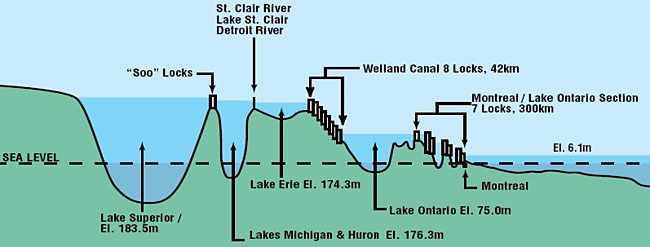
Time line of St. Lawrence Seaway


Canada, History, Canada History, St.Lawrence seaway History, Canals, History, Ontario, St Lawrence Seaway, Welland, Lake Erie, Lake Ontario


1680

A canal to bypass the Lachine Rapids  around Montreal & Lak St Louis was tried.  This project was spear headed by Dollier de Casson. He was the Superior of the Sulpician Seminary in Montreal.  This was not successful

1779
A great feat was made when a canal was begun to be made to have passage between Lak St Francis & Lak St. Louis.  It was the Royal Army Engineers to commence and finish this undertaking.  The Canals depth is at 0.76m.  There are 5 locks.  This project was completed by 1783. 
1824
A canal with 7 locks was completed.  At first it was known as the Casson Canal.  However the name has been changed to Lachine Canal
*Side Note taken from The Old Welland Canals Field Guide  http://www.oldwellandcanals.wikidot.com/feeder-canal


“The Feeder Canal was originally built in 1829 to bring water from the Grand River to the First Welland Canal. Over the years, however, the canal came to serve a much greater role as a shipping canal, even while the First and Second Welland Canals were taken out of operation.
The best way to understand the feeder canal is to make sense of the long series of events that changed how the canal was used.

  • 1829 - A dam is built on the Grand River at Dunnville. Raising the water level, the feeder canal is dug to bring water from behind the dam to the First Welland Canal in Port Robinson some 40 km away.
  • 1833 - Part of the Feeder Canal is incorporated into the First Welland Canal which is extended to Lake Erie. The Feeder Canal now ends just south of Welland.
  • 1842-1845 - The Second Welland Canal is built. The Feeder Canal is enlarged to allow shipping along its route. The upgrade gives the Second Welland Canal two routes to Lake Erie.
  • 1845-1850 - The Feeder Canal is used as the main channel while the Port Colborne route is deepened. A "Junction Lock" is built where the feeder canal empties into the Welland Canal. The feeder is also extended to Port Maitland where another lock is built to lower boats to the level of Lake Erie.”

1829
A schooner known as Ann and Jane was the first to navigate the almost completed Welland Canal.
1833
Welland Canal is now Completed with a system of 40 locks.  These are still wooden locks.  It is relatively long at 43.5 km.


Canada, History, Canada History, St.Lawrence seaway History, Canals, History, Ontario, St Lawrence Seaway, Welland, Lake Erie, Lake Ontario


These dates for the seaway is significant if your Ancestors had work with the canal systems.  So it could be your ancestors did not come to Western Canada as Loyalist.  Instead they could have been part of these very large projects.  Curious to know if Census records picked up these workers.
With all the migration that follows large construction projects there to can lead answers into family migration patterns.


Please read more about the canals at: 
Information comes from St. Lawrence Seaway  : From the Canadian Geographic Magazine July/August 2009, Inland superhighway: 300 years of history. http://www.canadiangeographic.ca/magazine/ja09/sw_timeline.asp


29 February 2012

29 February 1704 Where your Ancestors involved in Queen Anne's War?

Deerfield, MA Lost 50 Colonist on this day. 


The Raid on Deerfield (or the Deerfield Massacre[8]) occurred during Queen Anne's War on February 29, 1704, whenFrench and Native American forces under the command of Jean-Baptiste Hertel de Rouville attacked the Englishsettlement at Deerfield, Massachusetts, just before dawn, burning part of the town and killing 56 villagers.
French organizers of the raid drew on a variety of Indian populations, including in the force of about 300 a number ofPocumtucs who had once lived in the Deerfield area. The diversity of personnel involved in the raid meant that it did not achieve full surprise when they entered the palisaded village. The defenders of some fortified houses in the village successfully held off the raiders until arriving reinforcements prompted their retreat. More than 100 captives were taken, and about 40 percent of the village houses were destroyed.


Deerfield, MASS, Massachusetts, Queen Anne's War, 1704, Deerfield Massacre


 More detail at Wikipedia
Related Posts Plugin for WordPress, Blogger...