Showing posts with label England. Show all posts

16 December 2014

Sheriff Role in Old England

Anglo-Saxon local government (700–1066 AD)[edit]

The Kingdom of Wessex, c. 790 AD, was divided into administrative units known as shires. Each shire was governed by an Ealdorman, a major nobleman of Wessex appointed to the post by the King. The term 'Ealdorman' (meaning 'elder-man') gradually merged with the Scandinavian Eorl/Jarl (designating an important chieftain), to form the modern 'Earl'. However, the Shires were not comparable with later Earldoms, and were not held in the Ealdorman's own right.
The shires of Wessex at this time have essentially survived to the present day, as counties of England (currently ceremonial counties). They included Defnascir (Devon), Sumorsaete (Somerset), Dornsaete (Dorset), Wiltunscir (Wiltshire), Hamptunscir (Hampshire). When Wessex conquered the petty kingdoms of southern England, namely Cent and that of the South Saxons, these were simply reconstituted as shires (modern Kent and Sussex respectively).
As Wessex took over progressively larger areas of Mercia, East Anglia and Northumbria, the new lands were divided into shires, usually named after the principal town in the new shire; hence Northamptonshire, Oxfordshire, Derbyshire and so on. Most of the historic counties of England (and modern Ceremonial counties) south of the Mersey and Humber derive directly from this time.


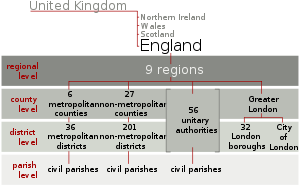
Another important official of the shire was the shire-reeve, from whence the more modern sheriff is derived. The shire-reeve was responsible for upholding the law, and holding civil and criminal courts in the shire.[1] The office of sheriff is still important in some Anglophone countries (e.g. the USA), but now a ceremonial role in the England


The early medieval period (1100–1300)[edit]

During the medieval period, local administration basically remained in the hands of the feudal aristocracy, who governed affairs in their fiefs. The enserfment of the population by the Norman system diminished the importance of hundreds as self-regulating social units since law was not imposed from above, and since the population was immobilised. Instead the basic social unit became the parish, manor or township.
The counties remained important as the basis for the legal system. The sheriff remained the paramount legal officer in each county, and each county eventually had its own court system for trials (the Quarter Sessions). Although the Hundred Courts continued in use resolving local disputes, they diminished in importance. During the reigns of Henry III, Edward I and Edward II a new system emerged. Knights in each county were appointed as Conservator of the Peace, being required the help keep the King's Peace. Eventually they were given the right to try petty offences which had formerly been tried in the Hundred Courts. These officers were the forerunners of the modern magistrates' courts and justices of the peace.


from Wikipedia: History of local government in England


15 December 2014

Ada De Balliol - Balliol married John FitxRober Clavering


House of Balliol


From Wikipedia, the free encyclopedia

The House of Balliol (de Bailleul) was a Picard and Anglo-Norman family originating from Bailleul who began to rule some estates in England in the reign of William Rufus. In the late 13th and 14th centuries, two members of the house were kings of Scotland.
 

List of heads of the Balliol estates[edit]

Both Balliols had English support for their claims; both were deposed. Edward died without issue, but the Balliol descent continued through his cousin Christine de Lindsay (granddaughter of John II), who married Enguerrand V de Coucy, to the lords of Coucy and ultimately the Bourbon kings of France and Spain.
 
source: all from Wikipedia

15 January 2013

Ireland & England Potato Famine 1845 - 1852 Ottoman EMpire & Chowtaw Nation Came to their Aid !!!


This Great Famine wiped 

Out 1 million or more people In Ireland & England.

Had great devastation of the people, especially poor families & caused migration. 
 Migration to England as well to the New World.
During this famine the Government did not block exports. 
 In fact it even increased exports of potatoes.
 The poor pheasant farmer life was one of desperation  
 There were of course other factors besides the "Blight", exports & greed that contributed to the effects of the famine.

I was very pleased and surprised to learn that when others around the world heard of the plight of the people.  That there were others that wanted to help the Irish people even though 
their own government would not.


Great Famine 1842-1852, Irish Farmers, Ireland, Ancestors, Ancestors, England, Ireland, Potato Famine, Ottoman Empire, Choctaw Nation,

First was from the: 

"*Ottoman aid

According to legend, in 1845, Ottoman Sultan Abdülmecid declared his intention to send £10,000 to Irish farmers but Queen Victoria requested that the Sultan send only £1,000, because she herself had sent only £2,000. The Sultan sent the £1,000 sterling but also sent three ships full of food. According to Abdullah Aymaz in an article in The Fountain magazine, the British administration tried to block the ships, but the food arrived secretly at Drogheda harbour and was left there by Ottoman sailors.[73][74] Uncertainty remains regarding the story as shipping records relating to the port at this time appear not to have survived.[75]

Then The:

From Native American Choctaw People

In 1847, midway through the Great Irish Famine (1845–1849), a group of Native American Choctaws collected money and sent it to help starving Irish men, women and children. "It had been just 16 years since the Choctaw people had experienced the Trail of Tears, and they had faced starvation... It was an amazing gesture." according to Judy Allen, editor of the Choctaw Nation of Oklahoma's newspaper, Bishinik, based at the Oklahoma Choctaw tribal headquarters in Durant, Oklahoma. To mark the 150th anniversary, eight Irish people retraced the Trail of Tears,[76] and the donation was publicly commemorated by President Mary Robinson." "

*Found information at Wikipedia you can read more on Wikipedia

29 November 2012

"Story Of England"

http://video.pbs.org/video/2253821318


Michael Wood "Story of England" , Kibworth, Central England, history
I really hope your able to enjoy and learn from watching Michael Wood’s “Story Of England on PBS video.


It so awesome how they have done this project. 

It centers on the Village of Kibworth in Central England.
Kibworth, Central England, history, England


Michael Wood "Story of England" , Kibworth, Central England, historyDigging small archeological dig pits
 looking carefully for what was
 left behind from the past.


Using ancient documents to support what knowledge has been passed down.

It is so incredible what they piece together.  I am really enjoying all the effort put into this exploration of England.

I am fascinated of how the Ancient England periods of time always came back as if it was some brand new idea.

England & hole of Europe has been a land of incredible pressure.     Revolution, Famine, Black Plaque etc..

25 November 2012

New Brick Wall: Wauker

William Wauker known facts about him:   

Born in Bristol Somerset England

He married Alice Payne on  20 Jan 1576 in Bristol Gloustershire England

His death is listed as in *1582 Bristol Somerset England

It very interesting that on Ancestry.com how quickly I found the marriage record for William & Alice.  Is it because it was on the other side known as Gloustershire instead of Somerset?  But why would Somerset hold back their records.    
Time will tell and get us to the correct birth & death records. 
As well hopefully as to the names of his parents.

Bristol,  Payne, Wauker,
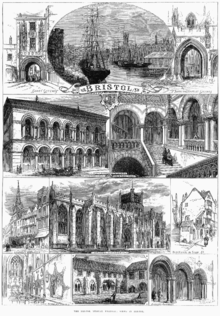
An 1873 engraving showing sights around Bristol
Image from wikipedia

New Brick Wall: Payne

In my search for Alice's parents I have not found them.  How can she be born without them?   We all know that the only way into our world is by live birth.  So she has to have a mother & father.  Where to find them?

Known facts:


Payne, Wauker,Gloustreshire England, New England 
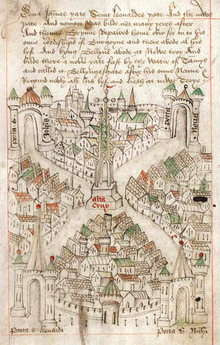
Robert Ricart's map of Bristol, drawn when he
became the common clerk of the town in 1478.
His drawing was the first such plan of an English town.
[13]
  Alice was born in Bristol Somerset England in 1559

  She married William Wauker 
on 20 Jan 1576

 
  Alice Died 1582 in Bristol England
 [note the county is split between Somersey & Gloustershire]

Can you help with any leads?


Image from wikipedia 

13 November 2012

Name Origin "Rufus"

Name Origins/from NEHGS

by Julie Helen Otto, Staff Genealogist


England, Rufus, d. 1100, dusyl, name origins, history


RUFUS (m) (Latin red): William II “Rufus” (d. 1100) succeeded his father, William I “the Conqueror,” as King of England in 1087 and was killed by an arrow while hunting in the New Forest. The name, used as a nickname (for red-headed or ruddy men, presumably) throughout medieval Europe, was revived as an English proper name in its own right in the late eighteenth century. 

Rufus Allen, Belligham MA, Belligham, Samuel Polly Allen

 Rufus Allen, b. Bellingham, Massachusetts, 27 Nov. 1824, was a son of Samuel and Polly (__) Allen.

07 November 2012

Barnard Castle a Town & a Castle

Ada Boilol, John F Clavering, Barnard Castle
Ada Baliol was born here
Barnard Castle in Barnard Castle England


Ada Boilol, John F Clavering, Barnard Castle


Ada Boilol, John F Clavering, Barnard Castle
all photos from the Net

21 August 2012

Family Name Eure


Eure family name   


Where does this name originate?

I find a river in northern France that is named Eure.  Does this family name originate in France? 

I do not have the answers to these questions. 
 However I did find a web site with information on the Eure family in England going way, way , way way, way way & way back in time. 

 I went as far today as 1220 with a Sir hugh de Eure.

You know my ma-tra verify before you accept it.  It always a good start when you find a tree that has most of what you yourself have researched.  That you have come to your conclusion you write it down as accepted Fact.  You make note of your source. As always someone else must be able to also look at the same info and be able to make their own conclusion.  Enough preaching on sourcing your info..

the web address as mentioned above is:

http://www.ourfamtree.org/browse.cfm/John-de-Eure/p303361

As always please share your discoveries with the rest of us seeking out the same family.

Happy Ancestor Hunting


Related Posts Plugin for WordPress, Blogger...