Names its so interesting where they come from

Name Origins
by Julie Helen Otto
|
ARMIDA (f): One of the main female characters in the epic Jerusalem Delivered by Torquato
Tasso (Italian Renaissance); the story also inspired several operas, such as
those by Jean-Baptiste Lully (1686), J.-W. Glück (1777), and G.A. Rossini (1817):
She was a beautiful sorceress, with whom Rinaldo [one of Charlemagne's paladins,
based on his nephew, the hero Roland] fell in love, and wasted his time in voluptuous
pleasure. Two messengers were sent from the Christian army with a talisman to
disenchant him. After his escape, Armida followed him in distraction, but not being
able to allure him back, set fire to her palace, rushed into the midst of a combat,
and was slain. (Brewer, p. 64).
Armida Potter (1765-1798, daughter of Dr. James and Abigail [Barns] Potter)
m. New Fairfield North (Sherman, Conn.) Congregational Church 23 Nov. 1797
Bennett Pickett (1764-1854), and apparently died bearing an only child,
Armida Pickett (1798-1826) who herself died unmarried. Why Dr. and
Mrs. Potter (several of whose offspring bear imaginative names) named one for
an apparently love-crazed sorceress, we cannot now determine; certainly such a choice
reflects eighteenth-century America's discovery of non-Puritan literature and ideals.
Perhaps Dr. Potter shared his reading material with the neighbors, as the name is more
common than usual in the Sherman/New Milford area. For example, Armida Giddings
(1773-1827, daughter of Jonathan and Mary [Baldwin] Giddings), later wife of David Gaylord,
was one of several siblings bp. New Fairfield North 26 May 1776; other local Armidas were
her niece, Armida Giddings (1815-1818, daughter of Samuel Giddings by his first marriage
to a cousin, Lydia Giddings) and Mrs. Gaylord's sister-in-law Armida (Sanford) Giddings
(1796-post 1881, daughter of Ebenezer and Jerusha [Buck] Sanford), second wife
of Samuel Giddings above.
 Armida
From Wikipedia, the free encyclopedia
The story of Armida, a Saracen sorceress and Rinaldo, a soldier in the First Crusade, was created by the Italian poet Torquato Tasso. In his epic Gerusalemme liberata, Rinaldo is a fierce and determined warrior who is also honorable and handsome. Armida has been sent to stop the Christians from completing their mission
and is about to murder the sleeping soldier, but instead she falls in love. She creates an
enchanted garden where she holds him a lovesick prisoner.
Eventually two of his fellow Crusaders find him and hold a shield to his face, so he can see
his image and remember who he is. Rinaldo barely can resist Armida’s pleadings,
but his comrades insist that he return to his Christian duties.
Many painters and composers were inspired by Tasso's tale.
The works that resulted often added or subtracted an element; Tasso himself continued to edit the story for years. In some versions, Armida is converted to Christianity, in others, she rages and destroys her own enchanted garden.
She occupies a place in the literature of abandoned women such as the tragic Dido,
but she is considered by many to be more human, and thus more compelling and sympathetic,
than either of them.
 |
Showing posts with label Naming traditions. Show all posts
Showing posts with label Naming traditions. Show all posts
13 June 2013
Name Origins: Armida


25 May 2013
Name Origins Boudica
I find Ancient names so fascinating Every week I am treated to rare names in the “Weekly Genealogist newsletter” sent by NEHGS.
This week it’s the name Boudica. I wiki ‘d her this week in search of deep history of England and the Roman occupation.

I am surprised Boudica was such a strong woman yet her name has not carried through history like one would think. I am thrilled to read this entry this week: Name Origins by Julie Helen Otto, Staff Genealogist BOADICEA (f): A Latinized form of BOUDICA, the widowed chieftainess of the Brythonic Celtic Iceni (who held lands in what is now Norfolk). In an arrangement common with client kingdoms in recently conquered Roman territory, her husband Prasutagus had willed his domain to his daughters and to Rome — which disregarded the daughters’ claims.
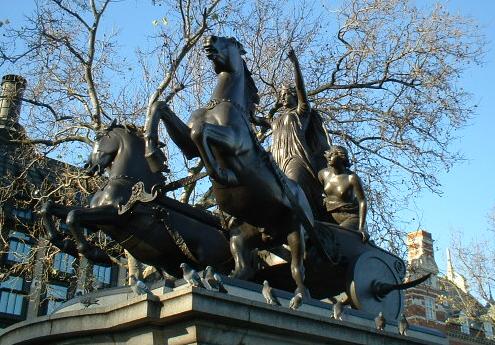
Boudica was subsequently severely flogged, her daughters raped; outraged by their treatment, she led the Iceni, Trinovantes, and other tribes in a bloody rebellion in A.D. 60/61 which led to the destruction of Camulodunum (Colchester, Essex), Londinium, and Verulamium (St. Albans), before the Romans crushed the uprising at the Battle of Watling Street. Boudica’s revolt was seen in later years as a heroic resistance to Roman tyranny in what is now England, and is commemorated in Thomas Thornycroft’s statue, “Boadicea and Her Daughters” (1901–2), by the Thames River near Westminster Pier, London. Boadicea Townsend m. Stafford, Conn. 20 Aug. 1771 Thomas Warner (Stafford, Conn. Congregational Church Records, Corbin Coll. [SG COR 5] 176, p. 14).
 From the NEHGS newletter
In about 1787 Thomas and Mehitable (Griggs) Wakefield of Enfield, Conn., had a daughter Boadice Wakefield, who died there 8 Sept. 1807 in her 20th year (“O: don’t forget that you must die, / and turn to dust as well as I”) (Francis Olcott Allen, The History of Enfield, Connecticut, Volume III, 3 vols. [Lancaster, Penn., 1900], 3:2479). At least one bearer of this rare given name used the nickname “Dicy” (which suggests di- could be the accented syllable). Boadicea “Dicy” Scott (not, so far as I know, related to either Mrs. Townsend or her daughter) m. Kent, Conn. (by Rev. Daniel Porter), 29 May 1802 William Brown of Kent (Kent VRs, Barbour Collection of Conn. VRs, citing orig. town rec. vol. 2:64). I really believe that there is so much more to the Legacy of Bodica. Would love to know what became of her children etc…

This week it’s the name Boudica. I wiki ‘d her this week in search of deep history of England and the Roman occupation.
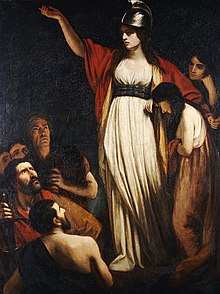
I am surprised Boudica was such a strong woman yet her name has not carried through history like one would think. I am thrilled to read this entry this week: Name Origins by Julie Helen Otto, Staff Genealogist BOADICEA (f): A Latinized form of BOUDICA, the widowed chieftainess of the Brythonic Celtic Iceni (who held lands in what is now Norfolk). In an arrangement common with client kingdoms in recently conquered Roman territory, her husband Prasutagus had willed his domain to his daughters and to Rome — which disregarded the daughters’ claims.
Boudica was subsequently severely flogged, her daughters raped; outraged by their treatment, she led the Iceni, Trinovantes, and other tribes in a bloody rebellion in A.D. 60/61 which led to the destruction of Camulodunum (Colchester, Essex), Londinium, and Verulamium (St. Albans), before the Romans crushed the uprising at the Battle of Watling Street. Boudica’s revolt was seen in later years as a heroic resistance to Roman tyranny in what is now England, and is commemorated in Thomas Thornycroft’s statue, “Boadicea and Her Daughters” (1901–2), by the Thames River near Westminster Pier, London. Boadicea Townsend m. Stafford, Conn. 20 Aug. 1771 Thomas Warner (Stafford, Conn. Congregational Church Records, Corbin Coll. [SG COR 5] 176, p. 14).

In about 1787 Thomas and Mehitable (Griggs) Wakefield of Enfield, Conn., had a daughter Boadice Wakefield, who died there 8 Sept. 1807 in her 20th year (“O: don’t forget that you must die, / and turn to dust as well as I”) (Francis Olcott Allen, The History of Enfield, Connecticut, Volume III, 3 vols. [Lancaster, Penn., 1900], 3:2479). At least one bearer of this rare given name used the nickname “Dicy” (which suggests di- could be the accented syllable). Boadicea “Dicy” Scott (not, so far as I know, related to either Mrs. Townsend or her daughter) m. Kent, Conn. (by Rev. Daniel Porter), 29 May 1802 William Brown of Kent (Kent VRs, Barbour Collection of Conn. VRs, citing orig. town rec. vol. 2:64). I really believe that there is so much more to the Legacy of Bodica. Would love to know what became of her children etc…
21 May 2013
Name Origins: CATO
CATO
Cato The Younger:
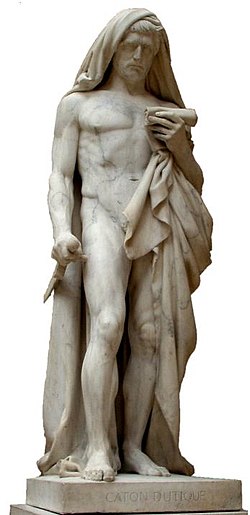
Marcus Porcius Cato Uticensis (95 BC, Rome – April 46 BC, Utica), commonly known as Cato the Younger (Cato Minor) to distinguish him from his great-grandfather (Cato the Elder), was a politician and statesman in the late Roman Republic, and a follower of the Stoic philosophy. A noted orator, he is remembered for his stubbornness and tenacity (especially in his lengthy conflict with Julius Caesar), as well as his immunity to bribes, his moral integrity, and his famous distaste for the ubiquitous corruption of the period.
Cato the Elder
From Wikipedia, the free encyclopedia
| Spouse(s) | Licinia Salonia |
|---|---|
| Children | Marcus Licinianus Cato Salonianus |
| Religion | Ancient Roman religion |
| Military service | |
| Allegiance |  Roman Republic |
| Rank | General |
| Battles/wars | Second Punic War Roman-Syrian War |
Marcus Porcius Cato[1] (234 BC, Tusculum – 149 BC) was a Roman statesman, commonly referred to asCensorius (the Censor), Sapiens (the Wise), Priscus (the Ancient), or Major, Cato the Elder, or Cato the Censor, (to distinguish him from his great-grandson, Cato the Younger) known for his conservatism and opposition to Hellenization.[2]
He came of an ancient Plebeian family who all were noted for some military service but not for the discharge of the higher civil offices. He was bred, after the manner of his Latin forefathers, to agriculture, to which he devoted himself when not engaged in military service. But, having attracted the notice of Lucius Valerius Flaccus, he was brought to Rome, and successively held the offices of Cursus Honorum: Military tribune (214 BC), Quaestor (204 BC), Aedile (199 BC), Praetor (198 BC), where he expelled the usurers from Sardinia, Consul (195 BC) together with his old patron, and finally Censor (184 BC), where he tried to preserve the mos majorum (“ancestral custom”) and combat "degenerate" Hellenistic influences.[2]
17 May 2013
Name Origins : Cephas
|
Name Origins
by Julie Helen Otto
|
|
CEPHAS (m.) - Cephas is another name for Simon Peter [St.
Peter] - fisherman, disciple, apostle and first bishop of Rome. CEPHAS
is the Syriac or Aramaic word for 'rock.' PETER (PETROS) is thus the same
idea in Greek.
A quick look at the Bellingham, Mass., VRs reveals a branch of the Rockwood family that used this name: Cephas Rockwood, b. 25 May 1766, son of Joseph and Alice (Thompson) Rockwood; he was lost at sea 10 Dec. 1786 off Lovell's Island (which the Bellingham town clerk, a notoriously bad speller, styled 'louvels eilon') (Bellingham VRs, pp. 55, 207); and his nephewCephas Rockwood, b. 12 March 1786, son of John and Eunice (____) (Smith) Rockwood (Bellingham VRs, p. 55); later known as Cephas Leland Rockwood (the middle name apparently honors his stepfather Aaron Leland), he lived many years at Chester, Vermont, later at Canton, N.Y., and died at Pewaukee, Wisconsin, 3 May 1844 (Vivian VaLera Rockwood,Four Centuries of American Descendants of Richard Rockwood of Dorchester 1633, Braintree 1636, Massachusetts, 2 vols. [Johnson City, Tenn.: The Overmountain Press, 2000], 1:176, 262, 367). The 1850 census lists 692 men with the name Cephas. |
A artist by the name of Cephas Giovanni Thompson [July 1, 1775 – November 6, 1856] was a New Englander Artist
with works such as these:


Name Origins: Clementina
Name Origins
by Julie Helen Otto
CLEMENTINA (f): Derived from the Latin clemens ("mild,
merciful") with addition of productive suffix -ina to the
adjective root, this name has long been used in England. In the seventeenth and
eighteenth centuries, the female name had strong Jacobite connotations; one of
the fabled romantic stories of that era was the journey in 1717/18, across much
of Europe, of [Maria Casimire] Clementina Sobieska (d. 1735), Princess
of Poland, to meet and marry James Francis Edward Stuart (1688-1736, the
Jacobite "James III"). Her namesake, Clementina Maria Sophia
Walkinshaw (ca. 1720-1802), mistress of their son "Bonnie Prince
Charlie" (Prince Charles Edward Stuart, 1720-1788, the Jacobite
"Charles III"), bore him several children. After the mid-1750s,
however, and the appearance of Samuel Richardson's Sir Charles Grandison (1753/4) - one of whose two heroines is the noble Italian Clementina
della Porretta - the name was favored by readers across
the political spectrum. Clementine was a variant form which
gained great currency in the mid-nineteenth century with the popular song
"Oh, My Darling Clementine," which requires no previous knowledge of
Richardson.
Clementina Janes (b. 1802), daughter of Peleg Cheney and
Patty (Coy) Janes of Brimfield, Mass., m. there 1 Jan. 1828 Edward Parsons of
Northampton, Mass. (Brimfield VRs, p. 207).Clementina (Ballou) Wright (1812-post
1888, daughter of Rev. Hosea and Ruth [Washburn] Ballou) had no issue by her
marriage to Col. Isaac Hall Wright, but namesakes included nieces (both b.
1834) Clementina (Ballou) Mason (daughter of Rev. Hosea Faxon
and Mary [Ballou] Ballou) and Clementina Clarissa (Ballou) Tucker (daughter
of Rev. Massena Berthier and Mary Sheffield [Jacobs] Ballou, who named their
daughter for two Richardson heroines), herself mother of Clemmie
Richmond Tucker (b. 1863).
14 November 2012
Name Origins
Name Origins from NEHGS
by Julie Helen Otto, Staff Genealogist of NEHGS
DINARZADA (f): In The Arabian Nights’ Entertainments (the title of the first English edition, published in 1706), Dinarzade was the sister of SCHEHEREZADE, the great teller of tales. Dinazada Covellwas baptized Edgartown, Mass. 13 Nov. 1774, daughter of Joseph and Judith (____) Covell (Edgartown VRs, p. 26).
13 November 2012
Name Origin "Rufus"
Name Origins/from NEHGS

RUFUS (m) (Latin red): William II “Rufus”
(d. 1100) succeeded his father, William I “the Conqueror,” as King of
England in 1087 and was killed by an arrow while hunting in the New
Forest. The name, used as a nickname (for red-headed or ruddy men,
presumably) throughout medieval Europe, was revived as an English proper
name in its own right in the late eighteenth century.

Rufus Allen, b. Bellingham, Massachusetts, 27 Nov. 1824, was a son of Samuel and Polly (__) Allen.
by Julie Helen Otto, Staff Genealogist
Rufus Allen, b. Bellingham, Massachusetts, 27 Nov. 1824, was a son of Samuel and Polly (__) Allen.
21 February 2012
English naming of Children
An English tradition for naming offspring.

1st son would be named in the patriarchal line.
* So 1st son is then named after his paternal grandfather. Dads dad.
2nd son named after maternal line. 2nd son named after his maternal grandfather. Moms dad.
3rd son will be named after after his own Daddy.
*4th son will bear the name of dads eldest brother. This one must be most confusing since all the younger brothers who have a fourth son. Will have a son of the same name. Could lead to 5 boys of the same generation all with the same name. In the same generation. Is it a wonder then a family of 5 sons -- then all 5 sons have large families. So they all name their 5th son the same name. This is the Paternal line. So for example there could be 5 cousins with the name of Thomas Moorehouse.
So the naming of the daughters follow pretty much the same way.
1st daughter is after the paternal grandmother. Dads mom.
2nd daughter will be given the name of her Moms Mom.
3rd daughter will bear the name of her own Mommy.
4th daughter will be given her moms oldest sisters name.
You know this is only a guide. It might help you to distinguish between folks when searching out a difficult family tree. No one can guarantee that all English families subscribed to this method. It is only a guide.
When my husband & I named our children.
It went like this:
1st son after my **husbands favorite brother.
2nd son after my husband but not as a Junior. But with what the *German call a saints name.
Our 1st daughter after paternal mother middle name
& Our 2nd daughter named after my moms middle name.
It was just how it happened nothing planned. Was never planned.
My eldest brother and his wife gave all of their children 3 names. I really like that they did that. All their names have a family name mixed in. It’s nice.
It great to see & hear how my nieces and nephews have named their children.
My one niece has 4 lovely children all named with first letter of “J”. Some great strong scriptural names there.
I can see how its like the names are so new but really they are so old.
** I refused to have a Junior. I always remember Mickey Rooney saying ever child needs their own name not their fathers name.
Subscribe to:
Posts (Atom)
