Showing posts with label name origins. Show all posts

08 February 2014

Name Origins:Pelagie

Name origins, Pelagie, of the sea, princess, family history, genealogy, art, vigee le brun,http://www.batguano.com/potocka2.jpg
Princess Pelagie Potocka 1798   by Vigee Le Brun her Russia Years
Pelagie, name origins,  Montreal, family history, genealogy, http://upload.wikimedia.org/wikipedia/commons/3/31/Hospice_de_Sainte_Pelagie_Wolfe_Street_Montreal.JPG
Hospice de Sainte Pelagie,  Rue de Wolfe, Montreal, Quebec     

13 August 2013

Name Origins


Name Origins
by Julie Helen Otto, Genealogist Of NEHGS newletter
Women's names, Asenath, Old Family photos, Family History, genealogy
Asenath Collins (1839-1870)
found at:  
http://freepages.family.rootsweb.ancestry.com/~garyscottcollins/
SENA (f): Often a nickname for ASENATH (or for any other name with middle or ending element -sen- [e.g. POLYXENA]. ASENATH is Old Testament Biblical, originally Egyptian ("And Pharaoh called Joseph's name Zaphnath-paaneah; and he gave him to wife Asenath, daughter of Potipherah, priest of On --" Gen. 41:45), while POLYXENA (not mentioned by Homer) was a Trojan princess, betrothed or married to Achilles (accounts differ) and sacrificed by the victorious Greeks on his tomb "to appease his shade." (Clarence L. Barnhart, William D. Halsey et al., The New Century Cyclopedia of Names, 3 vols. [1954], 3:3218). Here the specific meaning of a name has given way to phonetic convenience, if you will. In such cases it may be important to seek names in other forms: a woman may be Asenath in her birth record, Sena in her marriage record -- or Sena in her birth record and Polly X. at marriage.

Sena Luddington, daughter of Titus and Merriam Luddington, was born July 20, 1773, in Wallingford, New Haven County, Connecticut. (Connecticut Vital Records to 1870, The Barbour Collection, AmericanAncestors.org.) In his 1815 will, Joseph Van Falkenburgh of Sharon, Schoharie County, New York, gave $200 to his daughter, Sena Van Falkenburgh. (Abstracts of Wills, Admins. and Guardianships in NY State, 1787-1835, AmericanAncestors.org.)

19 July 2013

Name Origins GLORIANA

Name Origins
by Julie Helen Otto [of NEHGS  newsletter]
GLORIANA (f): In his book, American Given Names: Their Origin and History in the Context of the English Language (1979), George R. Stewart notes that this name, which means "glorious one [feminine]," was coined in the late sixteenth century by courtier poets to honor Queen Elizabeth I. The name was formed by adding the feminine adjective suffix "-ana" [of or pertaining to] to a base word, in this case "gloria" [glory]. Use of this name in colonial America generally bears strong Anglican connotations - Queen Elizabeth I (1533-1603, Queen from 1558) was considered to have re-founded the Church of England after the reign of her Catholic sister Queen Mary I Tudor (1516-1558, Queen from 1553).

Name origins, Gloriana, Elizabeth I, Womens names, Family history,

Name origins, Gloriana, Elizabeth I, Womens names, Family history, Genealogy

found at:  http://www.agecrofthall.com/Gloriana/pages/gloriana_index2.htm


Gloriana (Treadwell) Pell (1731-1814), was buried in St. Paul's Churchyard in the Bronx, New York, with the following inscription on her tombstone: In / Memory of / Gloriana / Relict of Philip Pell / who departed this Life / the 10th of Septr 1814 Aged 83 / Years, 4 Months & 28 Days. (Cemetery Transcriptions from the NEHGS Manuscript Collections onAmericanAncestors.org). She was named for a maternal aunt, Gloriana (Thomas) Stevenson, daughter (as was Mrs. Pell's mother, Margaret Thomas) of Rev. John Thomas, rector of St. George's Church, Hempstead, N.Y. (William A. Robbins, Descendants of Edward Tre(a)dwell through his Son John (New York: Tobias A. Wright Press, 1911), pp. 49-52, 74-75).

Gloriana Treadwell

Found 10 Records, 1 Photos and 192,254 Family Trees

Born on 12 Apr 1731 to Samuel Treadwell and Margaret Thomas. Gloriana married Philip Pell and had a child. She passed away on 10 Sep 1814.

   
The best-known Gloriana is Gloriana (Folsom) Sterling, b. Stratford, Conn., 24 Dec. 1753 to Samuel and Anne (Bingham) Folsom, who had come from Ashford, Conn. to Stratford in 1743, so he could make the ironwork for Christ Church (Episcopal), Stratford. Like most Anglican/Episcopal families of the time, her parents did not record her birth with the town clerk, so it's not in the Barbour Collection. She married at Stratford, 10 March 1771, John "Sterling," said to be son of a baronet in Scotland. He was summoned home and the good people of Stratford assumed desertion, even as daughter Mary Glorianna "Sterling" was baptized in Dec. 1771. The town was amazed when in fact he did send a ship for Gloriana and took her home to Scotland, where they produced many more children (not in Scottish OPRs, which suggests they were Scottish Episcopalians) and corresponded for many years with Stratford relatives. The whole story is given in Rev. Samuel Orcutt, The History of the Town of Stratford and City of Bridgeport, Connecticut, 2 vols. (1886), 1:448-451. (The given-name term glorian* produced 33 hits -- the earliest 1787 -- in the index to pre-1855 births and baptisms at the Scottish government site, www.scotlandspeople.gov.uk; among them is Gloriana Folsom Lapslie, baptized at Campsie, Stirlingshire, 20 Nov. 1797 [OPR Births 475/00 0020 0297 Campsie]).

13 June 2013

Name Origins : Aquila

Name Origins
by Julie Helen Otto 

AQUILA (m) (Latin ‘eagle’). In Christian iconography the eagle is a symbol
Of the Gospel of St. John. A man named Aquila was associated with St. Paul;
A later Aquila (fl. Early half 2nd century A.D.) translated the Hebrew Bible into
a very literal Greek. Both men are said to have been natives of Pontus [in Asia Minor], the latter prob. A native of Sinope in that region (Henry Wace and William C, Piercy, A Dictionary of Christian Biography and Literature to the End of the Sixth Century A.D., with an Account of the Principal Sects and Heresies [London: John Murray, 1911, repr. Peabody, Mass,: Henderson Publishers, 1994], pp. 38-39)

Aquila Chase, Aquila Purchase, Name Origins, Julie Helen Otto, NEHGS, Find A Grave, New England, Ancestors, Aquila, Star Constellation


Aquila Chase (1618-1670) was an early settler of Hampton, N.H. (1640) and Newbury, Massachusetts (1646).  John Carroll chase and George Walter Chamberlain, Seven Generations of the Descendants of Aquila and Thomas Chase (Derry, N.H. 1928, rev. ed. Camden, Maine: Picton Press, 1983, 1993), note that the exact parentage of the immigrant Aquila Chase and his brother Thomas seem to be still unknown: although several earlier English Aquila Chases have been identified in Chesham, Bucks and in London, no positive matches have been found this rare given name was Aquila Purchase od Kingweston, Somerset, and Dorchester, Mass., brother-in –law of Bernard Capen of Dorchester in Old and New England.  Both Chase and Purchase were likely names for Aquila, husband of Priscilla, mentioned by St. Paul.

Aquila Chase, Aquila Purchase, Name Origins, Julie Helen Otto, NEHGS, Find A Grave, New England, Ancestors, Aquila, Star Constellation


The 1790 census lists 21 men named Aquila, with occurrences from Vermont to South Carolina, with the largest number in Maryland. In 1850, there were 111

men with the  name, and, in 1940, there were 77.

Pictures found tru Google Images & Wikipedia.org

Name Origins: Armida

Names its so interesting where they come from
name origins, Naming traditions, Armida, Opera, First CrusadeJerusalem Delivered by Torquato  Tasso, Rinaldo


Name Origins
by Julie Helen Otto 
ARMIDA (f): One of the main female characters in the epic Jerusalem Delivered by Torquato
Tasso (Italian Renaissance); the story also inspired several operas, such as
 those by Jean-Baptiste Lully (1686), J.-W. Glück (1777), and G.A. Rossini (1817):

She was a beautiful sorceress, with whom Rinaldo [one of Charlemagne's paladins,
 based on his nephew, the hero Roland] fell in love, and wasted his time in voluptuous
 pleasure. Two messengers were sent from the Christian army with a talisman to 
disenchant him. After his escape, Armida followed him in distraction, but not being 
able to allure him back, set fire to her palace, rushed into the midst of a combat, 
and was slain. (Brewer, p. 64).

Armida Potter (1765-1798, daughter of Dr. James and Abigail [Barns] Potter)
 m.  New Fairfield North (Sherman, Conn.) Congregational Church 23 Nov. 1797
 Bennett Pickett (1764-1854), and apparently died bearing an only child, 
Armida Pickett (1798-1826) who herself died unmarried. Why Dr. and 
Mrs. Potter (several of whose offspring bear imaginative names) named one for 
an apparently love-crazed sorceress, we cannot now determine; certainly such a choice
 reflects eighteenth-century America's discovery of non-Puritan literature and ideals.
 Perhaps Dr. Potter shared his reading material with the neighbors, as the name is more 
common than usual in the Sherman/New Milford area. For example, Armida Giddings 
(1773-1827, daughter of Jonathan and Mary [Baldwin] Giddings), later wife of David Gaylord, 
was one of several siblings bp. New Fairfield North 26 May 1776; other local Armidas were
 her niece, Armida Giddings (1815-1818, daughter of Samuel Giddings by his first marriage
 to a cousin, Lydia Giddings) and Mrs. Gaylord's sister-in-law Armida (Sanford) Giddings 
(1796-post 1881, daughter of Ebenezer and Jerusha [Buck] Sanford), second wife 
of Samuel Giddings above.

name origins, Naming traditions, Armida, Opera, First CrusadeJerusalem Delivered by Torquato  Tasso, Rinaldo


Armida

From Wikipedia, the free encyclopedia

The story of Armida, a Saracen sorceress and Rinaldo, a soldier in the First Crusade, was created by the Italian poet Torquato Tasso. In his epic Gerusalemme liberata, Rinaldo is a fierce and determined warrior who is also honorable and handsome. Armida has been sent to stop the Christians from completing their mission
 and is about to murder the sleeping soldier, but instead she falls in love. She creates an
 enchanted garden where she holds him a lovesick prisoner. 
Eventually two of his fellow Crusaders find him and hold a shield to his face, so he can see 
his image and remember who he is. Rinaldo barely can resist Armida’s pleadings,
 but his comrades insist that he return to his Christian duties.
Many painters and composers were inspired by Tasso's tale. 
The works that resulted often added or subtracted an element; Tasso himself continued to edit the story for years. In some versions, Armida is converted to Christianity, in others, she rages and destroys her own enchanted garden. 
She occupies a place in the literature of abandoned women such as the tragic Dido,
 who committed suicide, and the evil Circe, whom Odysseus abandoned to complete his voyage, 
but she is considered by many to be more human, and thus more compelling and sympathetic, 
than either of them.

http://upload.wikimedia.org/wikipedia/commons/thumb/8/8f/Angelica_Kauffmann_-_Rinaldo_and_Armida_-_Google_Art_Project.jpg/704px-Angelica_Kauffmann_-_Rinaldo_and_Armida_-_Google_Art_Project.jpg

25 May 2013

Name Origins Boudica

I find Ancient names so fascinating Every week I am treated to rare names in the “Weekly Genealogist newsletter” sent by NEHGS.

 This week it’s the name Boudica.  I wiki ‘d  her this week in search of deep history of England and the Roman occupation.

Boudica, Welsh Queen, Boudica's husband Prasutagus, Roman Emperor,Londinium, Verulamium


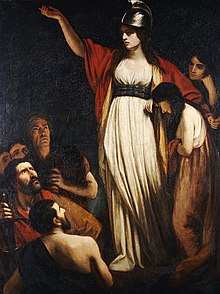
  I am surprised Boudica was such a strong woman yet her name has not carried through history like one would think.  I am thrilled to read this entry this week: Name Origins by Julie Helen Otto, Staff Genealogist  BOADICEA (f): A Latinized form of BOUDICA, the widowed chieftainess of the Brythonic Celtic Iceni (who held lands in what is now Norfolk). In an arrangement common with client kingdoms in recently conquered Roman territory, her husband Prasutagus had willed his domain to his daughters and to Rome — which disregarded the daughters’ claims.

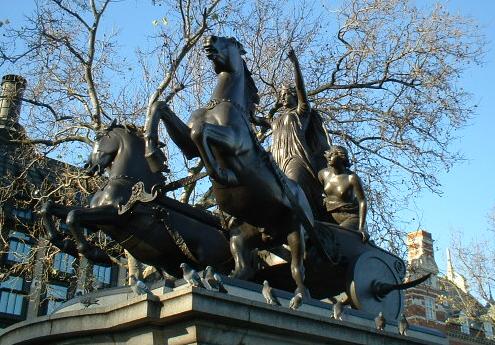
 Boudica was subsequently severely flogged, her daughters raped; outraged by their treatment, she led the Iceni, Trinovantes, and other tribes in a bloody rebellion in A.D. 60/61 which led to the destruction of Camulodunum (Colchester, Essex), Londinium, and Verulamium (St. Albans), before the Romans crushed the uprising at the Battle of Watling Street. Boudica’s revolt was seen in later years as a heroic resistance to Roman tyranny in what is now England, and is commemorated in Thomas Thornycroft’s statue, “Boadicea and Her Daughters” (1901–2), by the Thames River near Westminster Pier, London.  Boadicea Townsend m. Stafford, Conn. 20 Aug. 1771 Thomas Warner (Stafford, Conn. Congregational Church Records, Corbin Coll. [SG COR 5] 176, p. 14).

Boudica, Welsh Queen, Boudica's husband Prasutagus, Roman Emperor,Londinium, Verulamium
From the NEHGS newletter

In about 1787 Thomas and Mehitable (Griggs) Wakefield of Enfield, Conn., had a daughter Boadice Wakefield, who died there 8 Sept. 1807 in her 20th year (“O: don’t forget that you must die, / and turn to dust as well as I”) (Francis Olcott Allen, The History of Enfield, Connecticut, Volume III, 3 vols. [Lancaster, Penn., 1900], 3:2479). At least one bearer of this rare given name used the nickname “Dicy” (which suggests di- could be the accented syllable). Boadicea “Dicy” Scott (not, so far as I know, related to either Mrs. Townsend or her daughter) m. Kent, Conn. (by Rev. Daniel Porter), 29 May 1802 William Brown of Kent (Kent VRs, Barbour Collection of Conn. VRs, citing orig. town rec. vol. 2:64).   I really believe that there is so much more to the Legacy of Bodica.  Would love to know what became of her children etc…

Boudica, Welsh Queen, Boudica's husband Prasutagus, Roman Emperor,Londinium, Verulamium

22 May 2013

Name Origins: AMELIA

Name Origins
by Julie Helen Otto 
AMELIA (f): Derived from the Germanic root amal-, which is of uncertain meaning, this name became popular at about the same time as the similar-sounding EMILY, which is derived probably via French EMILIE, from Latin AEMILIA, feminine of a Roman family name. (The French equivalent of AMELIA is AMÉLIE.) Amelias abounded in many German royal families, including that of Hanover, a reason for much of the name's popularity in English-speaking countries. The name may well have gained further currency due to the character of Amelia in Henry Fielding's novel (1751) of that name; the virtuous heroine is said to have been modeled on the author's wife, Charlotte Cradock.

Amelia Potter, daughter of Stephen Potter, of Coventry, Rhode Island, married Chandler Holmes of Woodstock, Connecticut, in Woodstock on January 4, 1787 (Woodstock, Ct., Vital Records, 1686-1854 on AmericanAncestors.org). On May 21, 1856, Pascal B. Simons of Manchester, N.H., married Amelia Henry of Goffstown, N.H., in Goffstown. (Goffstown, N.H., Town Records, on AmericanAncestors.org).


& from Wikipedia:

Fictional characters 


21 May 2013

Name Origins: CATO

CATO

Cato The Younger:

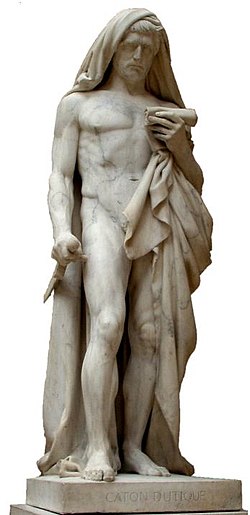
Marcus Porcius Cato Uticensis (95 BC, Rome – April 46 BC, Utica), commonly known as Cato the Younger (Cato Minor) to distinguish him from his great-grandfather (Cato the Elder), was a politician and statesman in the late Roman Republic, and a follower of the Stoic philosophy. A noted orator, he is remembered for his stubbornness and tenacity (especially in his lengthy conflict with Julius Caesar), as well as his immunity to bribes, his moral integrity, and his famous distaste for the ubiquitous corruption of the period.


family history, family lore, lore, familylore, genealogy, CATO, Cato, Kato

Cato the Elder

From Wikipedia, the free encyclopedia

Spouse(s)Licinia
Salonia
ChildrenMarcus Licinianus
Cato Salonianus
ReligionAncient Roman religion
Military service
AllegianceRoman Military banner.svg Roman Republic
RankGeneral
Battles/warsSecond Punic War
Roman-Syrian War
Marcus Porcius Cato[1] (234 BC, Tusculum – 149 BC) was a Roman statesman, commonly referred to asCensorius (the Censor), Sapiens (the Wise), Priscus (the Ancient), or Major, Cato the Elder, or Cato the Censor, (to distinguish him from his great-grandson, Cato the Younger) known for his conservatism and opposition to Hellenization.[2]
He came of an ancient Plebeian family who all were noted for some military service but not for the discharge of the higher civil offices. He was bred, after the manner of his Latin forefathers, to agriculture, to which he devoted himself when not engaged in military service. But, having attracted the notice of Lucius Valerius Flaccus, he was brought to Rome, and successively held the offices of Cursus Honorum: Military tribune (214 BC), Quaestor (204 BC), Aedile (199 BC), Praetor (198 BC), where he expelled the usurers from Sardinia, Consul (195 BC) together with his old patron, and finally Censor (184 BC), where he tried to preserve the mos majorum (“ancestral custom”) and combat "degenerate" Hellenistic influences.[2]

17 May 2013

Name Origins: Lavina

Name Origins
by Julie Helen Otto
LAVINIA (f): Female form of a Roman family name. In Roman legend, Lavinia was the daughter of King Latinus, king of Latium [the area around Rome: modern Lazio]. She married the Trojan newcomer Aeneas, hero of Vergil's Aeneid. Her name springs from the same root as the ancient city of Lavinium, about seventeen miles south of Rome. In Titus Andronicus, Shakespeare's bloodiest play, the eponymous hero has a daughter by this name (Clarence L. Barnhart, William D. Halsey et al., The New Century Cyclopedia of Names, 3 vols. [New York: Appleton-Century-Crofts, 1954], 2:2399).

Familiar forms often seen in New England are VINEY or VINNY. Lavinia Dickinson (1833-1899) of Amherst, Mass., sister of the poet Emily Elizabeth Dickinson (1830-1886), arranged for publication of Emily's poems after the poet's death. In the 1850 census, 5,195 women named Lavinia were enumerated. The 1940 census listed 4,436 women with that name.

In the PBS series Downton Abbey there was the Fiance of Matthew.  Her name was Lavina.

Images from google search:

Ancestor, family history, pioneers, Lavina womans name

Ancestor, family history, pioneers, Lavina womans name

Name Origins : Cephas

Name Origins
by Julie Helen Otto
CEPHAS (m.) - Cephas is another name for Simon Peter [St. Peter] - fisherman, disciple, apostle and first bishop of Rome. CEPHAS is the Syriac or Aramaic word for 'rock.' PETER (PETROS) is thus the same idea in Greek.

A quick look at the Bellingham, Mass., VRs reveals a branch of the Rockwood family that used this name: Cephas Rockwood, b. 25 May 1766, son of Joseph and Alice (Thompson) Rockwood; he was lost at sea 10 Dec. 1786 off Lovell's Island (which the Bellingham town clerk, a notoriously bad speller, styled 'louvels eilon') (Bellingham VRs, pp. 55, 207); and his nephewCephas Rockwood, b. 12 March 1786, son of John and Eunice (____) (Smith) Rockwood (Bellingham VRs, p. 55); later known as Cephas Leland Rockwood (the middle name apparently honors his stepfather Aaron Leland), he lived many years at Chester, Vermont, later at Canton, N.Y., and died at Pewaukee, Wisconsin, 3 May 1844 (Vivian VaLera Rockwood,Four Centuries of American Descendants of Richard Rockwood of Dorchester 1633, Braintree 1636, Massachusetts, 2 vols. [Johnson City, Tenn.: The Overmountain Press, 2000], 1:176, 262, 367). The 1850 census lists 692 men with the name Cephas.


A artist by the name of Cephas Giovanni Thompson [July 1, 1775 – November 6, 1856] was a New Englander Artist

with works such as these:  
lady in blue, Cephas, Artist, Fine Art, New England artist

Cephas, Fine Art, New England Artist, Painting


Name Origins: Clementina


Name Origins
by Julie Helen Otto

CLEMENTINA (f): Derived from the Latin clemens ("mild, merciful") with addition of productive suffix -ina to the adjective root, this name has long been used in England. In the seventeenth and eighteenth centuries, the female name had strong Jacobite connotations; one of the fabled romantic stories of that era was the journey in 1717/18, across much of Europe, of [Maria Casimire] Clementina Sobieska (d. 1735), Princess of Poland, to meet and marry James Francis Edward Stuart (1688-1736, the Jacobite "James III"). Her namesake, Clementina Maria Sophia Walkinshaw (ca. 1720-1802), mistress of their son "Bonnie Prince Charlie" (Prince Charles Edward Stuart, 1720-1788, the Jacobite "Charles III"), bore him several children. After the mid-1750s, however, and the appearance of Samuel Richardson's Sir Charles Grandison (1753/4) - one of whose two heroines is the noble Italian Clementina della Porretta - the name was favored by readers across the political spectrum. Clementine was a variant form which gained great currency in the mid-nineteenth century with the popular song "Oh, My Darling Clementine," which requires no previous knowledge of Richardson. 

Clementina Janes (b. 1802), daughter of Peleg Cheney and Patty (Coy) Janes of Brimfield, Mass., m. there 1 Jan. 1828 Edward Parsons of Northampton, Mass. (Brimfield VRs, p. 207).Clementina (Ballou) Wright (1812-post 1888, daughter of Rev. Hosea and Ruth [Washburn] Ballou) had no issue by her marriage to Col. Isaac Hall Wright, but namesakes included nieces (both b. 1834) Clementina (Ballou) Mason (daughter of Rev. Hosea Faxon and Mary [Ballou] Ballou) and Clementina Clarissa (Ballou) Tucker (daughter of Rev. Massena Berthier and Mary Sheffield [Jacobs] Ballou, who named their daughter for two Richardson heroines), herself mother of Clemmie Richmond Tucker (b. 1863).


23 April 2013

NAME ORIGINS: Brynhildr


Brynhildr

According to Wikipedia: 
Bryhildr, BroomHilda, Bruehila, Norse Goddess, Norse Mythology


Brynhildr (sometimes spelled Brunhild, Brünnhilde, Brynhild) is a shieldmaiden and a valkyrie in Norse mythology, where she appears as a main character in the Völsunga saga and some Eddic poems treating the same events. Under the name Brünnhilde she appears in the Nibelungenlied and therefore also in Richard Wagner's opera cycleDer Ring des Nibelungen. She may be inspired by the Visigothic princess Brunhilda of Austrasia. The history of Brynhildr includes fratricide, a long battle between brothers, and dealings with the Huns.

20 December 2012

Name Origins Ambrose

Name Origins

by Julie Helen Otto, Staff Genealogist

AMBROSE (from Late Latin family name AMBROSIUS) (m): 

The name came into use in the Middle Ages due to the great Church Father 
St. Ambrose, Bishop of Milan (339–397).

 While rather uncommon in Puritan New England (probably because of possible Catholic connotations), AMBROSE does appear in certain families and localities, often as a "marker" name; e.g. at Stratford, Conn., where it usually indicates descent from or associations with descendants of immigrants John and Mirable (Griggs?) Thompson, whose son Ambrose Thompson was born there 1 January 1651 [Barbour Collection].

Name Origins Mephi.

NAME ORIGINS
by Julie Helen Otto, Staff Genealogist NEHGS

 MEPHIBOSHETH (M): Hebrew. “And Jonathan, Saul’s son, had a son that was lame of his feet.  He was five years old when the tidings came of Saul and Jonathan out of Jezreel, and his nirse took him up, and fled: and it came to pass, as she made haste to flee, that he fell, and became lame.  And his name was MEPHIBOSHETH” (2 Samuel4:4). 

Mephibosheth Sanborn, b. 5, 9 mo. 1663, was the son of William and Mary (Moulton) Sanborn (Hampton VRs, 1:96, 552).

Rev. Mephibosheth Cain performed marriages at Dresden, Maine in the late 1790s. 

Were these men born lame, or was this a name randomly chosen from the Bible?

19 December 2012

Name Origins Christmas


Name Origins


by Julie Helen Otto, Staff Genealogist NEHGS


Christmas (m and f): Over time, the U.S. census has enumerated a number of people with the first name Christmas, both male and female. Most likely, the majority were born on or near Christmas Day. In 1790, there was one person listed in the census named Christmas: 

Christmas Hunt of Rehoboth, Bristol County, Massachusetts. 
In 1850, there were 37 people named Christmas; in 1880, 125 people; in 1910, 308 people; and, in 1940, there were 95 people named Christmas.
Ancestors, Putman, Hainer, Tessier, Tacey, DuCap, Gray, Trueblood, DeSpegiel, Sylvester, VanDerhurk, Van ValkenburgA search of the databases on AmericanAncestors.org also shows a number of examples, including

Christmas Dumore, son of Godfrey and Philomon (___) Dumore, who was born in Grafton, Massachusetts, on December 25, 1869, and

 Christmas L. Morse, daughter of Frank and Josephine (Gaudard) Morse, born in Adams, Massachusetts, on December 25, 1887.

14 November 2012

Name Origins


Name Origins from NEHGS

by Julie Helen Otto, Staff Genealogist of NEHGS
DINARZADA (f): In The Arabian Nights’ Entertainments (the title of the first English edition, published in 1706), Dinarzade was the sister of SCHEHEREZADE, the great teller of tales. Dinazada Covellwas baptized Edgartown, Mass. 13 Nov. 1774, daughter of Joseph and Judith (____) Covell (Edgartown VRs, p. 26).

Name origins, Pastees, Diarzada, NEHGS, namilg traditions

Related Posts Plugin for WordPress, Blogger...